
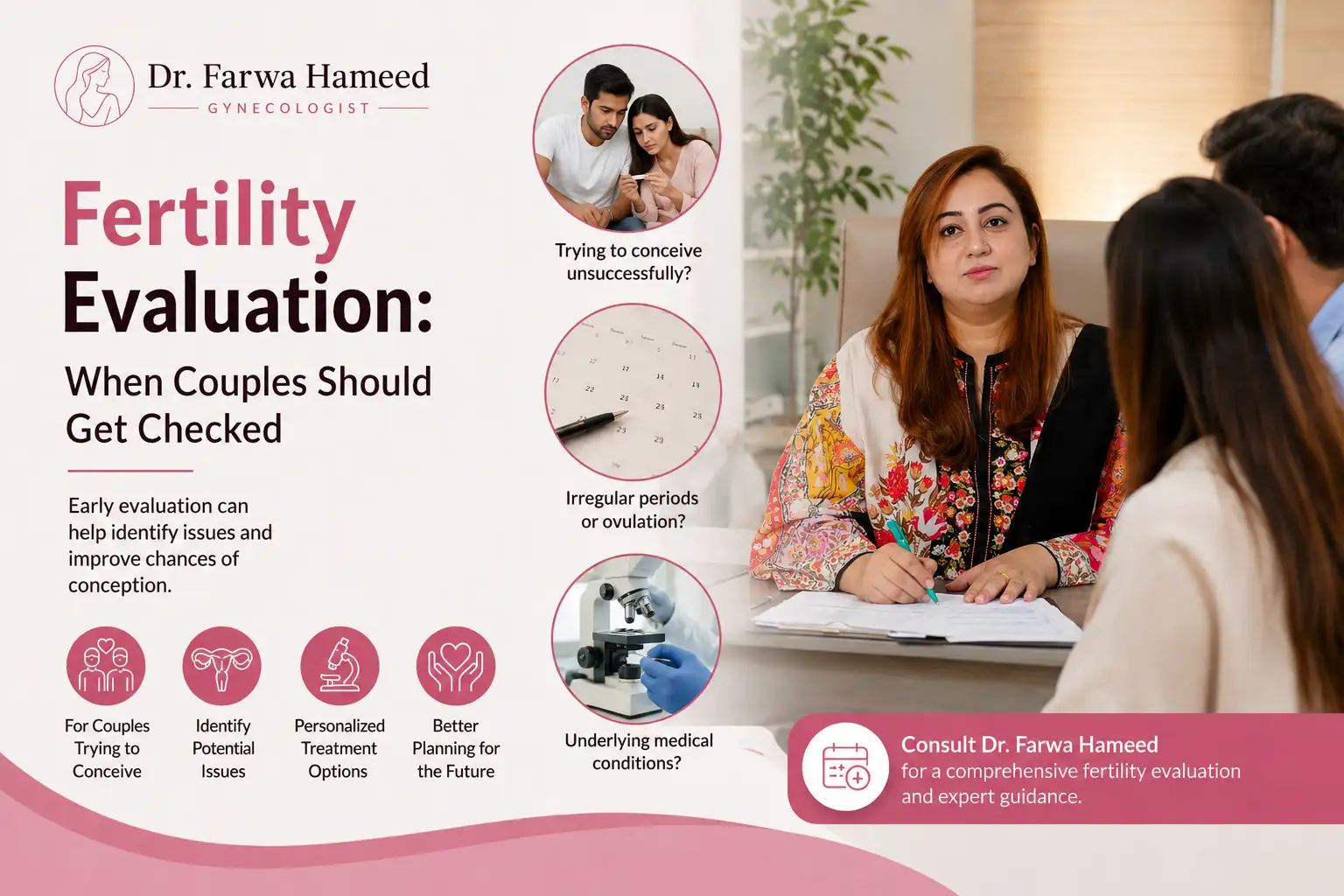
Trying to conceive can feel simple at the start. Most couples expect pregnancy to happen naturally within a few months. But when months pass and every cycle ends in disappointment, the stress slowly builds. Many couples in Islamabad delay seeing a doctor because they think they should “wait a little more” or because they are afraid of hearing something serious.
A fertility evaluation does not mean you are starting IVF. It does not mean something is badly wrong. It simply means a gynecologist checks both partners to understand why pregnancy has not happened yet and what can be done next. At Dr. Farwa Hameed, couples can discuss these concerns and understand the right next step with proper guidance.
For most couples, fertility evaluation is recommended after 12 months of regular unprotected intercourse if the female partner is under 35. If she is 35 or older, couples should get checked after 6 months. Some couples should come earlier, especially if there are irregular periods, PCOS, recurrent miscarriage, pelvic infection, endometriosis, prior pelvic surgery, or known male factor concerns.
Quick answer: when should couples get checked for fertility?
Couples should consider fertility evaluation if they have been trying to conceive for 12 months without success and the female partner is under 35. If the female partner is 35 or older, evaluation should start after 6 months of trying.
You should not wait a full year if there are clear warning signs. These include irregular or absent periods, known PCOS, previous pelvic infection, repeated pregnancy loss, endometriosis, previous pelvic surgery, or a known semen issue in the male partner.
Getting checked early can save time, reduce stress, and help couples understand whether they need simple cycle tracking, medicine for ovulation, further testing, or referral for advanced fertility care.
Not sure if it is the right time to get checked?
If you have been trying for several months and feel confused about the next step, a fertility consultation can help you understand whether testing is needed now or whether simple cycle guidance is enough.
Ask About Fertility EvaluationWhen should couples start thinking about fertility evaluation?
Fertility evaluation should not be seen as a last option. It is a practical first step when pregnancy is taking longer than expected. Many couples in Islamabad and Rawalpindi wait because they are told by relatives to be patient, avoid stress, or try home remedies. While patience is important, waiting too long can reduce treatment options, especially when age is already a factor.
Age matters for both partners, but it affects female fertility more strongly because egg number and egg quality naturally decline with time. Male fertility can also be affected by age, smoking, weight, diabetes, infections, varicocele, and lifestyle factors. This is why both partners should be included in the evaluation from the beginning.
A fertility checkup is not the same as starting treatment. In many cases, the first visit is only about understanding the couple’s history, reviewing cycles, checking basic tests, and deciding whether any issue needs attention. Some couples only need better timing, some need ovulation support, and some need further investigation.
If you are unsure whether your symptoms need a fertility visit or a general gynecology check-up first, this guide on when to see a gynecologist can help you decide the right time to book a consultation.
Reasons to get checked earlier than 12 months
Some couples should not wait for the full 12 months before seeking help. If there is already a medical clue that may affect fertility, early evaluation is more sensible. It gives the doctor time to identify the cause and guide the couple before more months are lost.
Irregular or absent periods
Irregular periods are one of the most common reasons couples should get checked earlier. If periods come every 40 to 60 days, disappear for months, or vary a lot from cycle to cycle, ovulation may not be happening regularly.
Common causes include PCOS, thyroid problems, high prolactin levels, stress, weight changes, and hormonal imbalance. PCOS is especially common in Pakistani women and often affects ovulation, weight, skin, hair growth, and insulin levels. If PCOS is suspected, proper diagnosis and targeted PCOS treatment in Islamabad can improve cycle regularity and fertility planning.
History of pelvic infection or STI
Pelvic infections can sometimes damage the fallopian tubes without causing obvious symptoms later. A woman may feel fine, have regular periods, and still have a tubal issue that prevents the egg and sperm from meeting.
If there is a history of pelvic inflammatory disease, untreated infection, repeated vaginal discharge with pain, or previous STI, it is better not to wait a full year. The doctor may recommend tests to check whether the tubes are open and whether the uterus and ovaries look healthy.
Prior miscarriage or pregnancy loss
One miscarriage is sadly common and does not always mean there is a fertility problem. But repeated pregnancy loss needs proper assessment. If a couple has had two or more miscarriages, the doctor may check hormones, uterus shape, thyroid function, diabetes, clotting-related issues, and other possible causes.
The emotional side also matters. Couples who have already gone through loss should not be told to simply “try again” without reviewing the full picture.
Endometriosis or prior pelvic surgery
Endometriosis can affect fertility by causing inflammation, pain, adhesions, ovarian cysts, or tubal problems. Some women know they have endometriosis, while others only suspect it because of severe period pain, pain during intercourse, or chronic pelvic discomfort.
Previous pelvic or abdominal surgery can also affect fertility, depending on what was done and whether scar tissue developed. Earlier evaluation helps the doctor understand whether the anatomy may be affecting conception.
Known male factor concerns
Fertility is not only a female issue. Male factors are common and should be checked early. A semen analysis is simple, non-invasive, and often one of the first tests recommended during fertility evaluation.
The semen report looks at sperm count, movement, shape, volume, and other basic markers. If there is a known history of testicular surgery, infection, injury, varicocele, diabetes, smoking, or previous abnormal semen report, the couple should not delay evaluation.
Have any of these signs?
Irregular periods, PCOS, previous miscarriage, pelvic infection, or a male factor concern are good reasons to get checked earlier instead of waiting a full year.
Book a ConsultationWhat does a fertility evaluation actually include?
A fertility evaluation is usually stepwise. A good doctor does not order every test for every couple on day one. The workup depends on age, duration of trying, cycle pattern, symptoms, previous pregnancy history, and male partner factors.
Detailed menstrual and medical history
The first part is a detailed conversation. Your doctor will ask about cycle length, bleeding pattern, period pain, discharge, previous pregnancies, miscarriage history, surgeries, infections, medicines, weight changes, acne, hair growth, and family history.
This history is important because it often points toward the likely cause before any test is ordered. For example, irregular periods may point toward ovulation problems, while severe pelvic pain may raise concern for endometriosis.
Ovulation assessment
Ovulation means the ovary releases an egg. If ovulation is not happening regularly, pregnancy becomes harder. Doctors may assess ovulation through cycle history, ultrasound tracking, and blood tests such as progesterone levels.
Hormonal tests may include AMH, Day 2 or Day 3 FSH and LH, thyroid function, prolactin, and other tests depending on the case. AMH gives an idea about ovarian reserve, while FSH and LH can help assess ovarian function and hormonal pattern. These numbers should always be interpreted with age, symptoms, and ultrasound findings.
Pelvic ultrasound
A pelvic ultrasound helps assess the uterus, ovaries, ovarian follicles, endometrial lining, fibroids, cysts, and signs that may suggest PCOS or endometriosis. It can also help estimate antral follicle count, which gives information about ovarian reserve.
Ultrasound is useful, but it does not answer everything. It cannot always confirm whether the tubes are open, and it should not be used alone to diagnose every fertility problem.
Partner evaluation and semen analysis
The male partner should be evaluated early in the process. A semen analysis is usually simple and gives useful information quickly. It checks sperm count, movement, shape, and volume.
This matters because many couples spend months testing only the woman, while the male factor remains unchecked. A balanced fertility evaluation includes both partners from the beginning.
Additional tests when indicated
Some couples may need further testing. This can include HSG to check whether the fallopian tubes are open, thyroid and prolactin tests, diabetes screening, infection screening, or more detailed hormonal assessment.
Not every couple needs all tests. The aim is to investigate wisely, avoid unnecessary cost, and focus on what is most likely to help the couple move forward.
What happens after the fertility evaluation?
After the evaluation, the next step depends on the results. Some couples have clear findings, such as irregular ovulation, PCOS, thyroid imbalance, tubal blockage, fibroids, or abnormal semen analysis. Others may have normal results, which is called unexplained infertility.
Unexplained infertility does not mean “nothing is wrong.” It means the basic tests did not show a clear cause. In such cases, your doctor may suggest timed intercourse, ovulation tracking, ovulation induction, or referral depending on age and how long you have been trying.
If ovulation is the issue, medicines may be used to help the ovaries release an egg. If timing is the issue, the couple may be guided about the fertile window. If semen parameters are abnormal, the male partner may need further evaluation. If tubes are blocked or advanced treatment is needed, referral to a fertility specialist or IVF center may be discussed.
Not every couple needs IVF. Many couples conceive with simpler treatment once the correct problem is identified. If advanced care is needed, proper fertility treatment in Islamabad can help guide the next step in a structured way.
Dr. Farwa’s clinical perspective
In my practice in Islamabad, the couples I see most often waited longer than they needed to. Not because they were not worried, but because no one had clearly told them when the right time to come in actually was. Many couples try for one year, then another few months, then try home remedies, and only come when the stress has already become heavy.
Another pattern I see often is that the woman is investigated again and again, while the male partner has never had a semen analysis. Fertility belongs to both partners. A couple should be assessed together, not as if the woman alone is responsible for conception.
My approach is stepwise. I do not believe in rushing every couple toward IVF before simpler causes have been checked. Sometimes the issue is irregular ovulation. Sometimes it is thyroid or prolactin. Sometimes it is timing. Sometimes it is a male factor. The right treatment starts with the right diagnosis.
With over 14 years of experience in gynecology, FCPS training, and MRCOG qualification, my goal is to help couples understand their situation clearly and choose the next step without panic, pressure, or unnecessary delay.
Fertility evaluation in Islamabad: what to expect at your first visit
At your first fertility visit, bring any previous test reports, ultrasound scans, semen reports, medicine history, and notes about your menstrual cycle. If you track periods on an app, bring that record too. It helps the doctor understand your cycle pattern quickly.
The first consultation usually includes a detailed history, review of previous reports, discussion of how long you have been trying, and a plan for the next tests. The partner does not always need to attend the first visit, but it is better if both partners are involved early because fertility evaluation includes both sides.
For couples looking for fertility evaluation in Islamabad, location and follow-up access matter. Dr. Farwa Hameed sees patients at clinic locations in Islamabad, including G-11 and G-13. You can check the available gynecologist locations in Islamabad and choose the clinic that is easier for you to visit.
When fertility evaluation is a reasonable next step
If you have been trying for 6 to 12 months, or if any of the conditions above apply to you, a fertility evaluation is a reasonable next step. You do not need to wait until you feel hopeless. You also do not need to assume that evaluation means advanced treatment.
The aim is to understand what is happening, identify anything that can be corrected, and create a plan that fits your age, health, cycle pattern, and family goals.
Book your fertility consultation in Islamabad
If you have been trying to conceive and are unsure whether it is time to get checked, Dr. Farwa Hameed can help you understand the right next step. In-person appointments and online consultations are available for couples in Islamabad, Rawalpindi, and nearby areas.
Medical note: This article is for general awareness and does not replace a personal consultation. Fertility testing and treatment should always be planned after reviewing both partners’ medical history and reports.