
Most women in Islamabad who have endometriosis go five to ten years before anyone gives them a proper diagnosis. That gap is not because the condition is rare. It affects roughly one in ten women of reproductive age. The gap exists because period pain gets normalized for so long that by the time a woman asks for help, she has already been told for years that heavy cramps are just part of being a woman.
This article walks through what endometriosis actually looks like, how it gets diagnosed, and what the treatment options are, so you can have a clearer conversation with your doctor instead of guessing. If you are searching for the best gynecologist in Islamabad to evaluate ongoing pelvic pain, this comparison should give you a starting point before your first visit.
What Endometriosis Actually Is
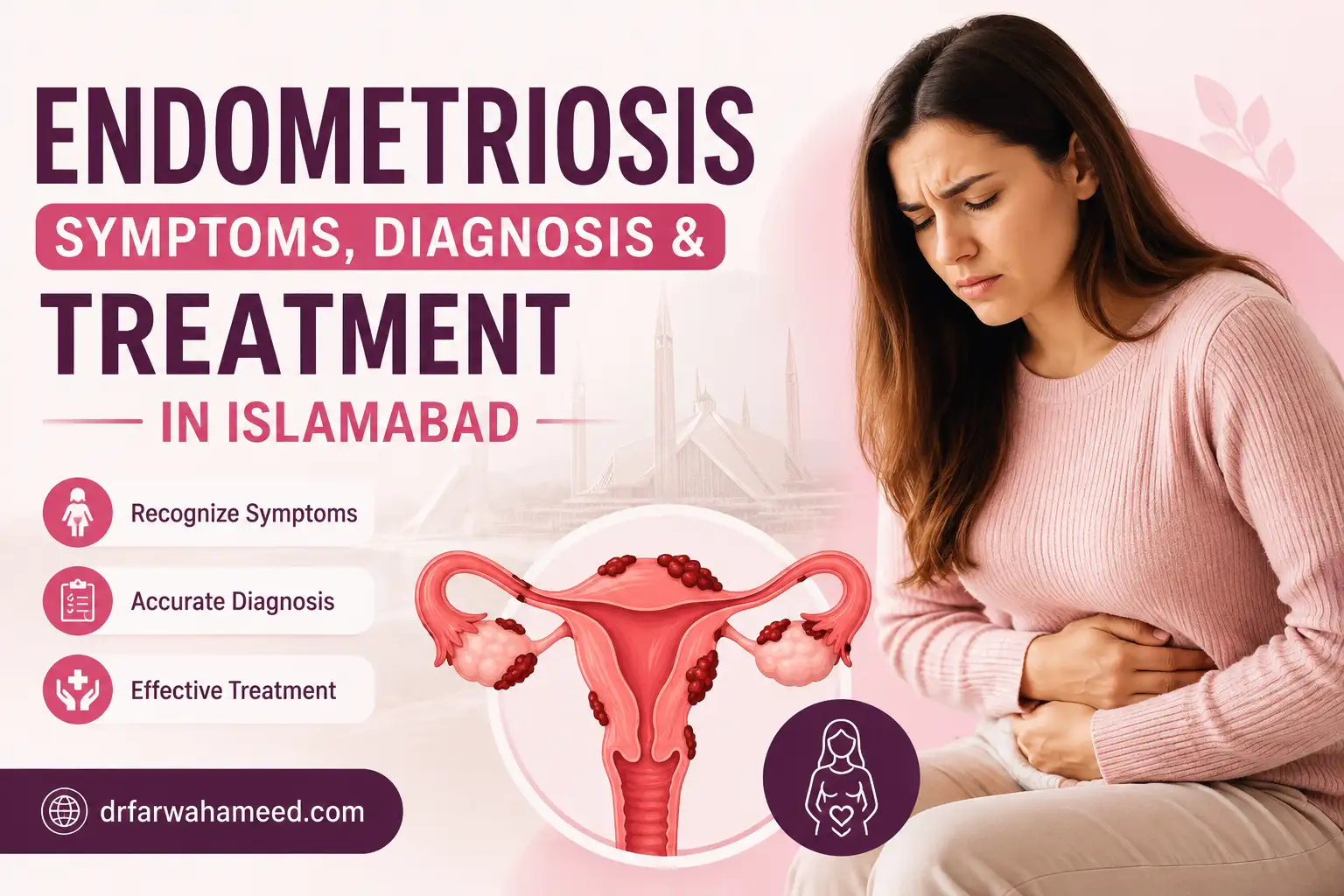
Endometriosis happens when tissue similar to the lining of the uterus grows outside it, usually on the ovaries, fallopian tubes, or the pelvic lining. That tissue still responds to your monthly hormone cycle. It thickens, breaks down, and bleeds the same way the uterine lining does, except it has nowhere to go. Over time this causes inflammation, scar tissue, and in some cases, cysts on the ovaries called endometriomas.
It is a chronic condition. There is no single pill that removes it permanently. But there are several ways to manage it, and the right choice depends on how severe your symptoms are and whether you are trying to conceive.
Symptoms: Endometriosis Pain vs Normal Period Pain
This is where most delays happen. Women are told period pain is supposed to hurt, so they don't always know when the pain has crossed into something that needs medical attention.
Normal period cramps usually last one to two days, respond well to a basic painkiller, and don't stop you from going to work or college.
Endometriosis pain tends to start before your period and last well beyond it. Painkillers that used to work stop being enough. Some women describe the pain as sharp or stabbing rather than a dull ache, and it can radiate to the lower back or thighs.
A few other signs that separate endometriosis from ordinary period discomfort:
- Pain during or after intercourse that isn't related to any infection
- Pain during bowel movements or urination, especially around your period
- Periods that are heavier than they used to be, or that involve passing large clots
- Fatigue that doesn't match how much you're actually bleeding
- Difficulty conceiving after a year of trying, with no other obvious cause
None of these symptoms alone confirms endometriosis. But if two or three of them sound familiar, it's worth getting checked rather than waiting another year to see if it settles down on its own.
Diagnosis Methods Compared
There isn't one test that gives you a yes or no answer instantly. Diagnosis usually happens in stages, starting with the least invasive option and moving up only if needed.
| Method | Accuracy | Cost | Invasiveness | Best Used For |
|---|---|---|---|---|
| Transvaginal ultrasound | Moderate, good at detecting cysts, weaker on small lesions | Lower cost | Non-invasive | First step for most patients |
| MRI | Higher accuracy for deep infiltrating endometriosis | Higher cost | Non-invasive | Complex cases or before surgical planning |
| Laparoscopy | Considered the gold standard, allows direct visual confirmation | Highest cost | Minor surgical procedure | Confirming diagnosis and treating lesions in the same procedure |
A transvaginal ultrasound is usually where things start. It's quick, doesn't require anesthesia, and can pick up endometriomas or thickened tissue. Its limitation is that small superficial patches of endometriosis often don't show up clearly.
If your doctor suspects deep endometriosis, involving the bowel or bladder, an MRI gives a much clearer picture before deciding on a treatment path. It costs more and takes longer to schedule, but it avoids unnecessary surgery in cases where the disease is manageable without it.
Laparoscopy is the only method that gives a confirmed diagnosis because the surgeon can actually see the tissue and take a biopsy if needed. What makes it practical rather than purely diagnostic is that many surgeons remove or treat visible lesions during the same procedure, so it often serves as diagnosis and treatment at once. It's still a surgical procedure, so it's not usually the first step. It's what happens once ultrasound or MRI findings point toward it, or when fertility is a concern and time matters.
If you're at the point where imaging has raised questions and you need a specialist opinion on next steps, this is a good moment to consult with a gynecologist near me who has experience specifically with endometriosis rather than general gynecology only.
Treatment Options Compared
Treatment isn't one size fits all. It depends on how much pain you're dealing with, whether you want to conceive soon, and how advanced the disease is.
| Treatment | Best Suited For | Recovery Time | Effect on Fertility |
|---|---|---|---|
| Pain management (NSAIDs) | Mild, occasional symptoms | None, no procedure involved | No direct effect |
| Hormonal therapy (birth control pills, progestins, GnRH agonists) | Moderate symptoms, patients not currently trying to conceive | None | Temporary suppression, generally reversible after stopping |
| Laparoscopic excision surgery | Moderate to severe cases, or when fertility is a priority | One to two weeks | Often improves natural conception chances |
| Combined approach (surgery followed by hormonal management) | Severe or recurring endometriosis | Varies by case | Depends on extent of disease and age |
Pain management with NSAIDs is usually the starting point for mild cases. It doesn't slow the disease down, it just makes the pain bearable during flare-ups.
Hormonal therapy works by reducing or stopping ovulation, which slows the growth of endometrial tissue outside the uterus. Birth control pills are the most common starting point because they're affordable and reversible. GnRH agonists are stronger and usually reserved for more severe cases, partly because of side effects like temporary bone density loss with long-term use.
Laparoscopic surgery removes visible endometriosis tissue and any scar tissue that's formed. This is often the recommended route when a woman is trying to conceive, since removing the lesions tends to improve the chances of natural pregnancy compared to hormonal suppression alone, which doesn't help fertility at all while you're on it.
For women dealing with both endometriosis and fertility concerns together, it helps to speak with a fertility specialist in Islamabad early rather than after months of trying on your own, since the treatment plan often needs to balance pain relief with conception timelines.
Endometriosis vs PCOS: Why the Confusion Happens
A lot of women get these two conditions mixed up, partly because both involve irregular periods and pelvic discomfort, and partly because both can affect fertility. But they're different conditions with different causes.
PCOS is a hormonal imbalance that affects ovulation and often comes with weight changes, acne, and excess hair growth. Endometriosis is a structural condition where tissue grows in the wrong places, and it doesn't typically cause the metabolic symptoms PCOS does. It's possible to have both at the same time, which is part of why an accurate diagnosis matters instead of assuming one explains everything.
If irregular cycles and pelvic pain are both part of your picture, getting evaluated for PCOS alongside endometriosis testing gives a fuller picture instead of treating one and missing the other.
Choosing Where to Get Evaluated in Islamabad
A general gynecology consultation is a reasonable first step if your symptoms are mild and recent. But if you've had pelvic pain for years, if painkillers have stopped working, or if you're struggling to conceive, it's worth seeking out a doctor with specific experience in laparoscopic diagnosis and treatment of endometriosis rather than general gynecology alone.
Ask directly during your first consultation how many endometriosis cases the doctor manages regularly and what their approach to diagnosis looks like, whether they start with ultrasound, move to MRI when needed, and how they decide when surgery is the right call. A doctor who can walk you through that decision process clearly is usually a good sign that they take the condition seriously rather than treating every case with the same generic plan.
Living With Endometriosis Long Term
Even after treatment, endometriosis can come back, particularly if hormonal therapy is stopped or after certain types of surgery. That doesn't mean treatment failed. It means this is a condition you manage over years rather than fix once.
Regular follow-ups, tracking how your symptoms change over time, and staying in touch with your gynecologist about any new pain patterns all matter more with endometriosis than with most other gynecological conditions.
If you've been putting off a proper evaluation because you assumed the pain was just something to live with, that assumption is usually wrong. A proper diagnosis, even if it takes a couple of appointments and one or two scans, gives you an actual plan instead of years of guessing.