
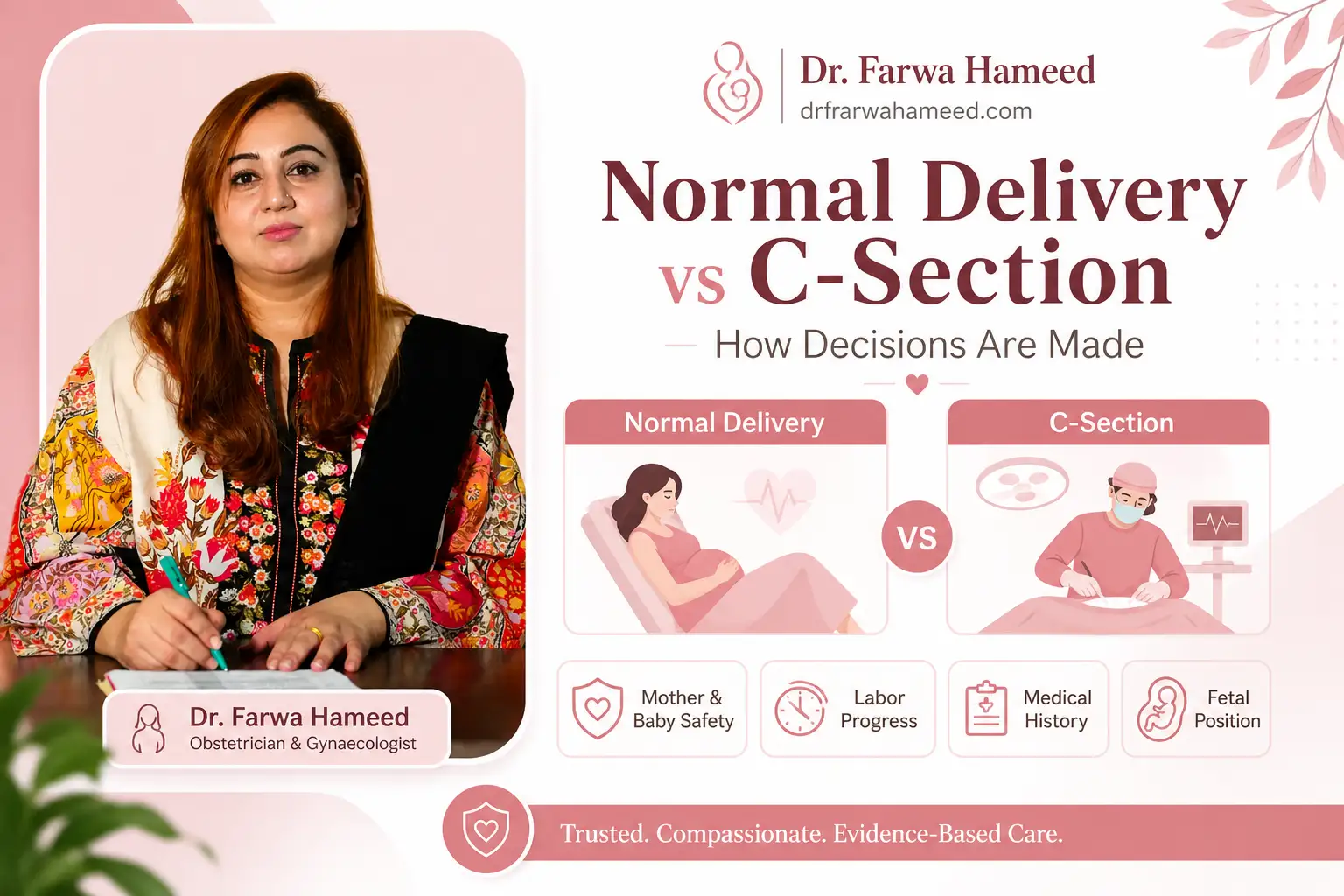
Many expecting mothers ask one important question during pregnancy: “Will I have a normal delivery or C section?” This question is very common, especially for first-time mothers who are already dealing with body changes, family advice, online opinions, and fear of labour pain.
The truth is simple: the decision is not made by guesswork. A gynecologist looks at the mother’s health, baby’s position, baby’s heartbeat, ultrasound reports, previous delivery history, and labour progress. Normal delivery is usually preferred when pregnancy is low-risk, but C section becomes the safer option when vaginal birth may put the mother or baby at risk.
For mothers in Islamabad, timely checkups with an experienced gynecologist can make this decision clearer before labour starts. At Dr. Farwa Hameed, the focus is to guide mothers with honest advice and safe pregnancy care.
Confused about normal delivery or C section?
A delivery consultation can help you understand your chances of normal delivery, possible risk factors, and when a C section may become necessary for safety.
Discuss Your Delivery PlanQuick Answer: Who Decides Normal Delivery or C Section?
The gynecologist decides the safest delivery method after checking the mother and baby’s condition. The mother’s preference matters, but the final decision depends on medical safety.
Normal delivery may be possible if the baby is head-down, the mother is healthy, and labour is progressing normally. C section may be needed if the baby is in distress, labour stops progressing, placenta position is unsafe, or the mother has a serious health concern.
Normal Delivery vs C Section: Main Difference
| Point | Normal Delivery | C Section |
|---|---|---|
| Birth method | Baby is delivered through the birth canal | Baby is delivered through surgery |
| Recovery | Usually faster | Usually slower |
| Hospital stay | Often shorter | Often longer |
| Pain after birth | Less surgical wound pain | Abdominal wound pain is common |
| Best for | Low-risk pregnancy | High-risk or complicated pregnancy |
| Timing | Happens after labour starts | Can be planned or done in emergency |
Normal delivery and C section are both medical options. One is not always better than the other. The safest choice depends on the condition of the mother and baby at that time.
When Normal Delivery May Be Recommended
Normal delivery may be suitable when the pregnancy is stable and there are no major risks. Your doctor may support normal delivery if the baby is head-down, the baby’s heartbeat is normal, mother’s blood pressure is controlled, blood sugar is under control, labour pain starts naturally, the cervix opens properly, the baby moves down during labour, there is no serious bleeding, and placenta position is normal.
For many mothers, regular check-ups during pregnancy help doctors understand whether normal delivery is possible. If you are still in your pregnancy planning stage, proper pregnancy care in Islamabad can help monitor mother and baby health from the start.
When C Section May Be Needed
A C section is not a failure. It is a medical decision that can protect the mother and baby when normal delivery becomes risky.
A doctor may recommend C section if the baby is breech or sideways, baby’s heartbeat becomes abnormal, labour is not progressing, placenta is covering the cervix, there is heavy bleeding, mother has severe high blood pressure, baby is too large for safe vaginal birth, mother had certain previous uterine surgeries, or emergency delivery is needed.
Need clarity before your due date?
If you are worried about labour pain, previous C section, baby position, or delivery risks, discussing your case early can help reduce last-minute confusion.
Book a Delivery ConsultationPlanned C Section vs Emergency C Section
| Type | What It Means | Common Reason |
|---|---|---|
| Planned C section | Decided before labour starts | Breech baby, placenta issue, previous complicated C section |
| Emergency C section | Decided during labour | Baby distress, bleeding, labour not progressing |
A planned C section gives the mother and doctor time to prepare. An emergency C section is done when quick action is needed. In both cases, the purpose is safety.
How Doctors Make the Final Decision
Mother’s Health
The doctor checks blood pressure, diabetes, anemia, infections, previous surgeries, and overall pregnancy condition. If the mother has uncontrolled blood pressure, severe weakness, bleeding, or another serious issue, the delivery plan may change.
Baby’s Position
A head-down baby usually supports normal delivery. If the baby is breech, transverse, or not moving into the right position, C section may be discussed.
Baby’s Heartbeat
During labour, doctors monitor the baby’s heartbeat. If the heartbeat shows distress, it may mean the baby is not getting enough oxygen. In this situation, doctors may recommend urgent delivery.
Labour Progress
Normal delivery depends on labour progress. The cervix should open, contractions should become stronger, and the baby should move down. If labour stops for many hours or the baby does not move down, C section may become necessary.
Previous Delivery History
If a mother had a previous C section, the doctor checks whether vaginal birth after C section is possible. This decision needs careful assessment because every pregnancy and previous surgery history is different.
Is Normal Delivery Always Better Than C Section?
No. Normal delivery is not always better, and C section is not always unnecessary.
Normal delivery may have faster recovery and a shorter hospital stay, but it is not safe in every case. C section is a major surgery, but it can be life-saving when there is a risk to the mother or baby.
The best delivery is the one that keeps both mother and baby safe.
Can You Choose Normal Delivery or C Section?
You can share your preference with your doctor. Some mothers want normal delivery, while others feel more comfortable discussing planned C section. Your choice matters, but the final plan depends on medical condition.
If pregnancy is low-risk, your gynecologist may support normal delivery. If there are warning signs, the doctor may recommend C section. The right approach is to discuss your fears, previous birth history, pain concerns, and family plans with your doctor early.
If you are close to your due date, you can also explore professional delivery services in Islamabad to understand your options before labour begins.
Questions to Ask Your Gynecologist Before Delivery
| Question | Why It Matters |
|---|---|
| Is my pregnancy low-risk or high-risk? | Helps understand delivery options |
| Is my baby in the right position? | Baby position affects delivery method |
| What are my chances of normal delivery? | Gives realistic expectations |
| When would C section become necessary? | Helps reduce fear during labour |
| Can I try normal delivery after C section? | Important for mothers with previous C section |
| What warning signs should I watch for? | Helps prepare for emergencies |
Asking these questions does not mean you are worried too much. It means you are preparing wisely.
Why Delivery Planning Matters for Mothers in Islamabad
In Islamabad, many mothers receive different opinions from family, friends, and online groups. Some people say normal delivery is always best. Others say C section is easier. Both statements are incomplete.
Every pregnancy is different. A mother living in DHA, G-11, G-13, F-8, Blue Area, or nearby areas should have access to proper medical guidance before delivery. Regular visits, ultrasound review, blood pressure monitoring, and honest discussion with a gynecologist can help avoid last-minute confusion.
For clinic access and nearby consultation options, you can check the main gynecologist locations in Islamabad.
How to Prepare for a Safe Delivery
You cannot control every part of labour, but you can prepare your body and mind.
Attend antenatal check-ups on time. Keep your ultrasound and lab reports safe. Eat healthy meals. Stay active if your doctor allows it. Control blood sugar and blood pressure. Discuss your birth plan with your gynecologist before your due date.
You can also read these healthy pregnancy tips to understand small habits that support a safer pregnancy journey.
Final Thoughts
Normal delivery vs C section is not a competition. It is a medical decision based on safety. Normal delivery may be suitable for low-risk mothers, while C section may be the safest choice when complications appear.
If you are expecting a baby in Islamabad, discuss your delivery plan early with your gynecologist. The more informed you are, the more confident you will feel when the time comes.