
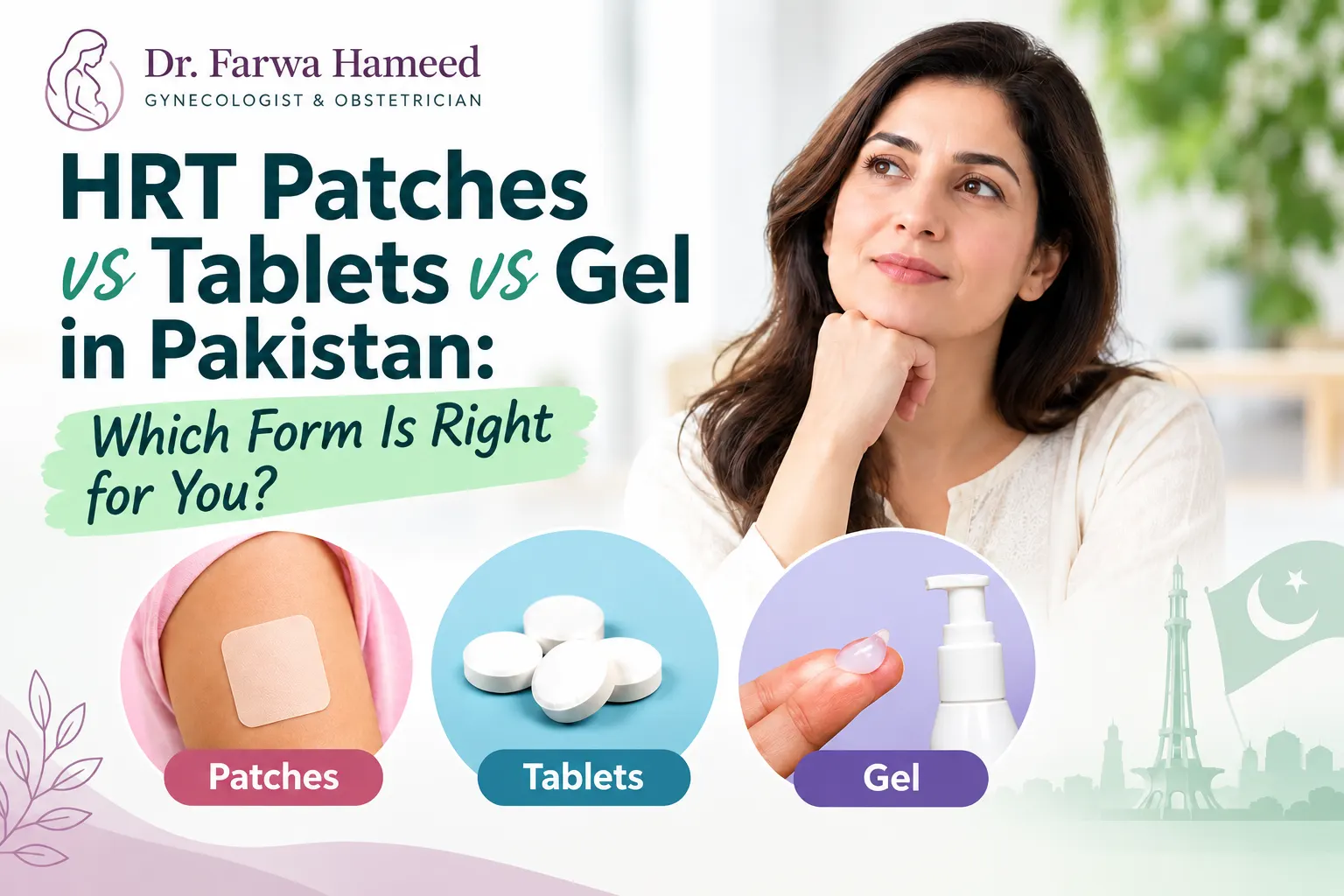
HRT patches, tablets and gel all deliver estrogen, but they reach your body in different ways, so the right form depends on your symptoms, your health history and whether you still have a uterus. Patches and gel (the transdermal route) are often chosen for women with a higher risk of blood clots. Tablets suit many healthy women who prefer a daily pill.
This guide compares each form side by side, explains why doctors sometimes lean towards a transdermal patch, and covers what is specific to Pakistan: availability, prices, fake stock and online consultation. For the wider picture of treatment, see our page on HRT in Pakistan.
None of this replaces a consultation. HRT is a prescription medicine, and the best choice is personal.
Who HRT is for?
HRT is mainly for women whose menopause symptoms, such as hot flushes, night sweats, poor sleep, low mood and vaginal dryness, are getting in the way of daily life.
Menopause usually happens between 45 and 55. The years before it, called perimenopause, often start with changes in your cycle.
HRT works best for women under 60, or within 10 years of their last period, because that is when benefits and risks balance most favourably. Women who reach menopause early, or whose ovaries stop working before 40, are usually advised to take HRT until at least the average age of menopause unless there is a medical reason not to. HRT also helps protect bones.
In women over 45, menopause is usually recognised from your age and symptoms, so a hormone blood test is often not needed.
Beyond hot flushes, other symptoms include joint aches, brain fog, palpitations, more frequent urinary infections and a drop in sexual desire. These are easy to blame on stress or age, which is why many women live with them for years.
It is not the only option. Non hormonal treatments exist, and our overview of menopause medicine in Pakistan explains them alongside HRT.
HRT forms compared: tablets, patches, gel and vaginal estrogen
There are four main forms of HRT: tablets, patches, gel or spray, and vaginal estrogen. Each one suits a different situation.
| Form | How you use it | Often suits | Points to watch |
|---|---|---|---|
| Tablet (oral) | One tablet daily, estrogen alone or combined with a progestogen | Healthy women with no clot risk factors who prefer a pill | Passes through the liver first. Clot risk is higher than with patches or gel, and there is a small rise in stroke risk |
| Patch (transdermal) | Stuck on the lower belly or buttock and changed once or twice a week, depending on the brand | Women with a higher clot risk, migraines, or trouble tolerating tablets | Skin irritation. Can peel off in heat and sweat |
| Gel or spray | Applied daily to the arms, shoulders or thighs | Women who dislike patches or want easier dose adjustment | Must dry before dressing. Avoid skin contact with others while it dries |
| Vaginal estrogen (cream, tablet, pessary or ring) | Placed in the vagina, daily at first and then a few times a week | Vaginal dryness, painful intercourse, urinary symptoms | Treats local symptoms only. It does not control hot flushes |
Estrogen patches come as estrogen only or as combined patches that include a progestogen. Your doctor sets the strength and adjusts it after a few months. If you are unsure which form fits you, a menopause specialist can narrow it down after a full history.
Why doctors sometimes prefer HRT patches?
Doctors often prefer patches for women at higher risk of blood clots, because transdermal estrogen skips the first pass through the liver. UK guidance from NICE and the British Menopause Society states that clot risk is higher with oral HRT than with transdermal HRT, and that transdermal HRT at standard doses carries no greater risk than not taking HRT.
A patch or gel may be the better starting point if you:
- have a BMI over 30 or other clot risk factors
- get migraines
- feel nauseous on tablets
- have gut or absorption problems that make tablets less reliable
Patches also give steadier hormone levels, and oral (but not transdermal) estrogen carries a small rise in stroke risk.
Patches can irritate the skin and, in Pakistan's summer heat, sometimes lift at the edges. Gel is a good alternative then.
I choose between patch, gel and tablet after a full history, not by habit.
HRT medicine in Pakistan: availability and why you need a prescription
HRT is available in Pakistan, but brands and strengths vary by city and pharmacy, and it should only be bought with a prescription. Some patches are imported and not always in stock, so ask your doctor for equivalent options.
Buying without a prescription carries real risks:
- Missed warning signs. Unexplained bleeding or a breast lump should be checked before any hormone is started, and our guide on when to see a gynecologist explains what needs attention.
- Fake or expired stock. Counterfeit and expired medicines are a known problem in the market, and online sellers are the biggest risk.
- Wrong dose or form. A strength that is too high or too low can cause side effects or leave symptoms untreated.
- Missing progestogen. Taking estrogen alone with a uterus can thicken the lining.
If you are prescribed HRT, buy it from a licensed pharmacy. Check the pack for a registration number, batch number and expiry date, and ask the pharmacist to confirm the product is registered with DRAP. Avoid products sold through social media or messaging apps.
HRT patches price in Pakistan
There is no single price for HRT patches in Pakistan. The cost varies by brand, strength and the number of patches in the pack, so no fixed rate is listed here. This page was last updated on October 29, 2026.
Ask your doctor to name two or three suitable brands, then ask the pharmacy for the current price. Compare the cost per month, not per box, because a patch pack may last two weeks while a tablet strip lasts a month.
Tablets, patches and gel are priced differently, but the cheapest option is not always the safest one for you.
Who should not take HRT, and why progesterone is added?
HRT is usually avoided if you have had breast or womb cancer, have unexplained vaginal bleeding (see irregular bleeding), active blood clots, a recent heart attack or stroke, or active liver disease.
Other conditions need extra care and a closer look, including migraine with aura, high blood pressure, gallbladder disease, and a strong family history of breast cancer or clots. Your doctor will go through these with you before prescribing.
If you still have a uterus, you need a progestogen alongside estrogen. Estrogen alone can thicken the uterine lining over time and raise the risk of womb cancer. The progestogen keeps the lining thin. It can be taken as micronised progesterone, another progestogen, or a hormonal coil. Women who have had a hysterectomy usually take estrogen alone.
On breast cancer, combined HRT is linked with a small increase in risk that rises with the length of use. Estrogen alone shows little or no change. Vaginal estrogen is absorbed in very small amounts, and your doctor will explain how that applies to you.
Bioidentical HRT: myths vs facts
Bioidentical means a hormone with the same structure as one your body makes, and many standard prescription HRT products already meet that description.
Myth: bioidentical HRT is a natural, safer alternative to regular HRT.
Fact: Regulated estradiol patches and gels and micronised progesterone are already body identical. "Natural" does not mean risk free, and the same safety checks apply. If you are unsure about a product you were offered, you can book a consultation and bring the pack with you.
Myth: custom hormones, tailored by saliva tests, are more precise.
Fact: Saliva hormone testing is not a reliable guide for dosing, and compounded products may not have consistent strength. Menopause societies do not recommend them.
Myth: you do not need progesterone with bioidentical estrogen.
Fact: If you have a uterus, you still need a progestogen to protect the lining.
If a clinic or online seller offers "custom bioidentical" creams or pellets, ask what the product is, who makes it and whether it is registered. Bioidentical HRT in Pakistan is also sold by unverified online sellers.
How to consult online for HRT from anywhere in Pakistan?
You can consult Dr. Farwa Hameed online from anywhere in Pakistan by booking through our contact page. The consultation covers your symptoms, your history and which form of HRT may suit you.
Here is how it usually works:
Some women need an examination or tests first, for example with unexplained bleeding. Dr. Farwa will tell you, and you can read about her training and experience before you book.