Most women know their cycle well enough to notice when something is off. Maybe it came two weeks early, or it is now three weeks late, or the bleeding is heavier than usual and you are not sure whether to wait it out or get it checked. These are the questions Dr. Farwa Hameed, a gynecologist in Islamabad with 14 years of clinical experience in women's health, hears almost every day.
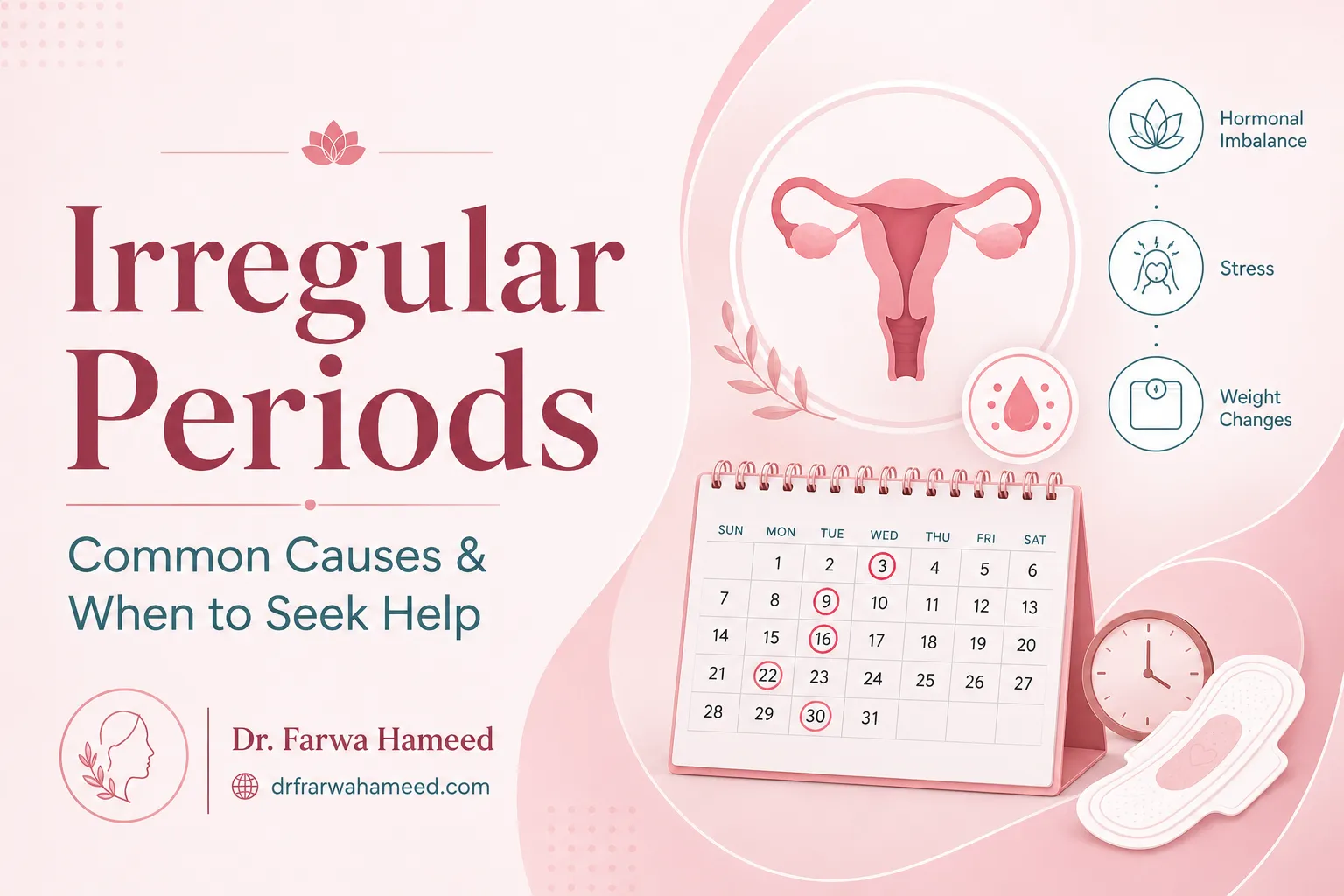
The difficulty with irregular periods is that the causes range from completely harmless, like stress or a change in routine, to conditions that need proper treatment. This article covers what actually counts as irregular, what causes it, the warning signs that should not be ignored, and how an evaluation works so you know what to expect before you book.
Need help choosing the right gynecologist?
If your concern is pregnancy, PCOS, fertility, irregular periods, or menopause, choosing a gynecologist with the right experience can make your consultation more useful.
Ask About Appointment AvailabilityWhat "Irregular" Actually Means
A normal menstrual cycle runs anywhere from 21 to 35 days. The first day of one period to the first day of the next is how you count it. Most women naturally sit somewhere in the middle of that range and stay fairly consistent month to month. Variation of a few days is normal.
When Variation Becomes a Pattern
A single late or early period is usually not a concern. The question becomes more relevant when the change is consistent, three or more cycles in a row that are significantly shorter, longer, heavier, lighter, or absent. A sudden shift from your personal baseline, even within the 21 to 35 day range, is also worth noting if it comes with other symptoms.
Spotting, Heavy Bleeding, and Missed Periods: What's Different
These three things get grouped together but they are clinically different:
- Spotting is light bleeding between periods, sometimes just a few drops.
- Heavy bleeding, or menorrhagia, means soaking through a pad or tampon in an hour or less for several hours in a row.
- A missed period means the cycle did not arrive within the expected window, or stopped altogether.
Each one can have its own cause. Spotting mid-cycle is sometimes normal around ovulation; heavy bleeding can suggest fibroids or a hormonal issue; a missed period needs to rule out pregnancy first before looking at other causes.
Not sure if your period pattern is normal?
If your cycle is repeatedly early, late, missed, very heavy, or different from your usual pattern, a gynecology consultation can help identify the cause.
Ask About Irregular PeriodsCommon Causes of Irregular Periods
There is no single cause. What follows are the ones that come up most often in clinical practice, roughly in order of how commonly they appear.
PCOS
Polycystic ovary syndrome is the most common hormonal disorder in women of reproductive age. In PCOS, the ovaries produce excess androgens, which interferes with ovulation. When ovulation is irregular or absent, the period either does not come or arrives unpredictably.
Women with PCOS often notice other signs alongside the cycle changes: acne that does not clear, hair thinning at the crown, weight gain around the abdomen, or excess facial hair. These signs together are worth investigating, not just monitoring.
PCOS is treatable. Depending on whether the goal is cycle regulation, symptom control, or improving fertility, the treatment plan can vary from patient to patient. A proper clinical approach to PCOS treatment helps identify the main cause, manage hormonal imbalance, and choose the right care plan according to each woman's needs.
Thyroid Imbalance
Both an underactive thyroid, known as hypothyroidism, and an overactive thyroid, known as hyperthyroidism, can affect the menstrual cycle. Hypothyroidism often causes heavier, more frequent periods or irregular cycles, while hyperthyroidism tends to make periods lighter or cause them to stop.
The thyroid regulates overall metabolism and hormonal balance, so when it is off, the cycle is one of the first places it shows. A simple blood test, the TSH test, checks thyroid function and is usually part of any standard workup for irregular periods.
Stress and Lifestyle Factors
The body reads significant stress, whether from work, sleep deprivation, or emotional strain, as a signal to suppress non-essential functions. Ovulation, from the body's perspective, falls into that category under stress. Elevated cortisol can delay or prevent ovulation, which pushes back or skips the period entirely.
This is not dangerous on its own, but if it continues for months, it is not something to just manage with rest. It needs to be checked to rule out other causes.
Sudden Weight Changes
Body fat plays a role in oestrogen production. When weight drops sharply, usually through aggressive dieting or excessive exercise, the body may reduce oestrogen to conserve energy, which stops ovulation. On the other side, significant weight gain can raise oestrogen levels and also disrupt the cycle.
Both directions can affect periods. Women who have recently changed their diet significantly or started intense training and notice a cycle change at the same time should mention it to their doctor.
Perimenopause
For women in their late 30s or 40s, irregular periods can be an early sign of perimenopause, the transition period before menopause. Oestrogen levels start to fluctuate, ovulation becomes less predictable, and periods may arrive earlier or later than usual, or vary in flow.
This is normal but it does not mean the irregularity should be ignored. Other causes still need to be ruled out, and some women in this age group benefit from assessment and management.
Hormonal Contraception
Starting, stopping, or switching hormonal birth control, including the pill, injection, implant, or hormonal IUD, can cause cycle changes for several months. This is usually temporary. If cycles do not normalize within three to four months of stopping, or if the changes are unexpected while on contraception, it is worth checking.
Pregnancy and Early Pregnancy Loss
A missed period is the most common early sign of pregnancy. Spotting in early pregnancy is also common and can be mistaken for a light period. Miscarriage, including very early loss before a pregnancy is confirmed, can cause irregular bleeding that looks like an unusual period. A pregnancy test is always the first step if there is any possibility of conception.
Other Causes
Uterine fibroids, endometriosis, elevated prolactin, and certain medications can also cause cycle changes. These are less common but important enough to check when the more obvious causes have been ruled out. A proper clinical evaluation will usually cover these.
When to See a Gynecologist, Not Wait
A lot of women wait longer than they should, partly because they assume it will sort itself out and partly because they are not sure what actually needs attention. Here is a clear way to think about it.
Book an Appointment This Week If:
- Your periods have been irregular for three or more consecutive cycles.
- Your cycle has suddenly changed with no obvious reason like travel, illness, or a new medication.
- You are noticing irregular periods alongside hair loss, unexplained weight gain, or persistent acne.
- Periods are very heavy, meaning soaking through a pad hourly for more than two hours, or lasting longer than seven days.
- You have been trying to conceive for six months or more with no success.
These situations are not emergencies, but they do not belong in the "wait and see" category. Early assessment gives you a clear diagnosis and, where treatment is needed, gives it time to work.
If the irregular cycles are connected to difficulty getting pregnant, a fertility treatment consultation will include a full evaluation of both partners and a specific plan based on the cause.
Irregular periods with fertility concerns?
If you have been trying to conceive for six months or more and your cycles are irregular, it is better to get checked early instead of waiting.
Book a Fertility ConsultationSeek Same-Day or Urgent Care If:
- You are soaking through a pad every hour and it has been going on for several hours.
- You are experiencing severe pelvic pain with bleeding.
- You feel dizzy, faint, or are short of breath during a heavy bleed.
- You have confirmed or possible pregnancy with any bleeding.
- Bleeding has returned after more than 12 months without a period.
These situations need same-day evaluation, not a booked appointment. Go to the clinic directly or call ahead.
What Happens During the Evaluation
One reason women delay seeking help is not knowing what to expect. The process is straightforward.
At the first visit, Dr. Farwa will ask about your cycle history: when it changed, how long it has been irregular, what the flow is like, and whether there are any other symptoms. If you are unsure about exact dates, an approximate timeline is enough. For a full picture of what happens at your first gynecology visit, including what to bring and what questions to expect, the linked page covers it in detail.
Depending on the history, the initial tests will likely include a pelvic ultrasound, a hormone panel, and a thyroid function test. These three together cover the most common causes. Results usually come back within a few days and lead directly into a treatment plan or further investigation if something specific needs follow-up.
You do not need to arrive with a diagnosis. You just need to describe what you have been experiencing and the evaluation takes it from there.
Need help understanding your symptoms?
You do not need to know the cause before booking. Share your cycle pattern, symptoms, and concerns, and the evaluation will guide the next step.
Book a Private ConsultationCan Irregular Periods Affect Fertility?
Yes, and it is one of the most common fertility concerns Dr. Farwa evaluates. Irregular periods usually mean irregular ovulation. Without consistent ovulation, the fertile window is unpredictable, which makes timed conception harder.
The reassuring part is that most of the causes of irregular ovulation are treatable. PCOS-related irregularity responds well to management and fertility outcomes are good when it is caught early. Thyroid-related irregularity often resolves once thyroid levels are corrected.
Women who have been trying to conceive for six months or more without success, especially with irregular cycles, should not wait for the one-year mark. Six months is the right threshold when ovulation is already known to be irregular.
When to Book an Appointment for Irregular Periods in Islamabad
If your period has been irregular for several cycles, suddenly changed from your normal pattern, become very heavy, or is linked with acne, hair growth, hair loss, weight changes, or fertility concerns, it is better to book a gynecologist appointment instead of waiting.
For women in Islamabad and nearby areas, Dr. Farwa Hameed provides evaluation and treatment for irregular periods, PCOS, thyroid-related cycle problems, fertility concerns, hormonal imbalance, and other women’s health issues.
Book a Consultation in Islamabad
If your cycle has been off for a few months and you are not sure why, the most useful thing you can do is get it checked. A single consultation usually gives you enough information to understand what is happening and whether it needs treatment.
Dr. Farwa Hameed practices at Saeed International Hospital in G-11 Markaz, Monday to Saturday, 12:30 PM to 3:00 PM, and Hyaat Hospital in G-13/1, Monday to Saturday, 6:00 PM to 9:00 AM. You can book an appointment via the contact form or reach the clinic directly on WhatsApp.