
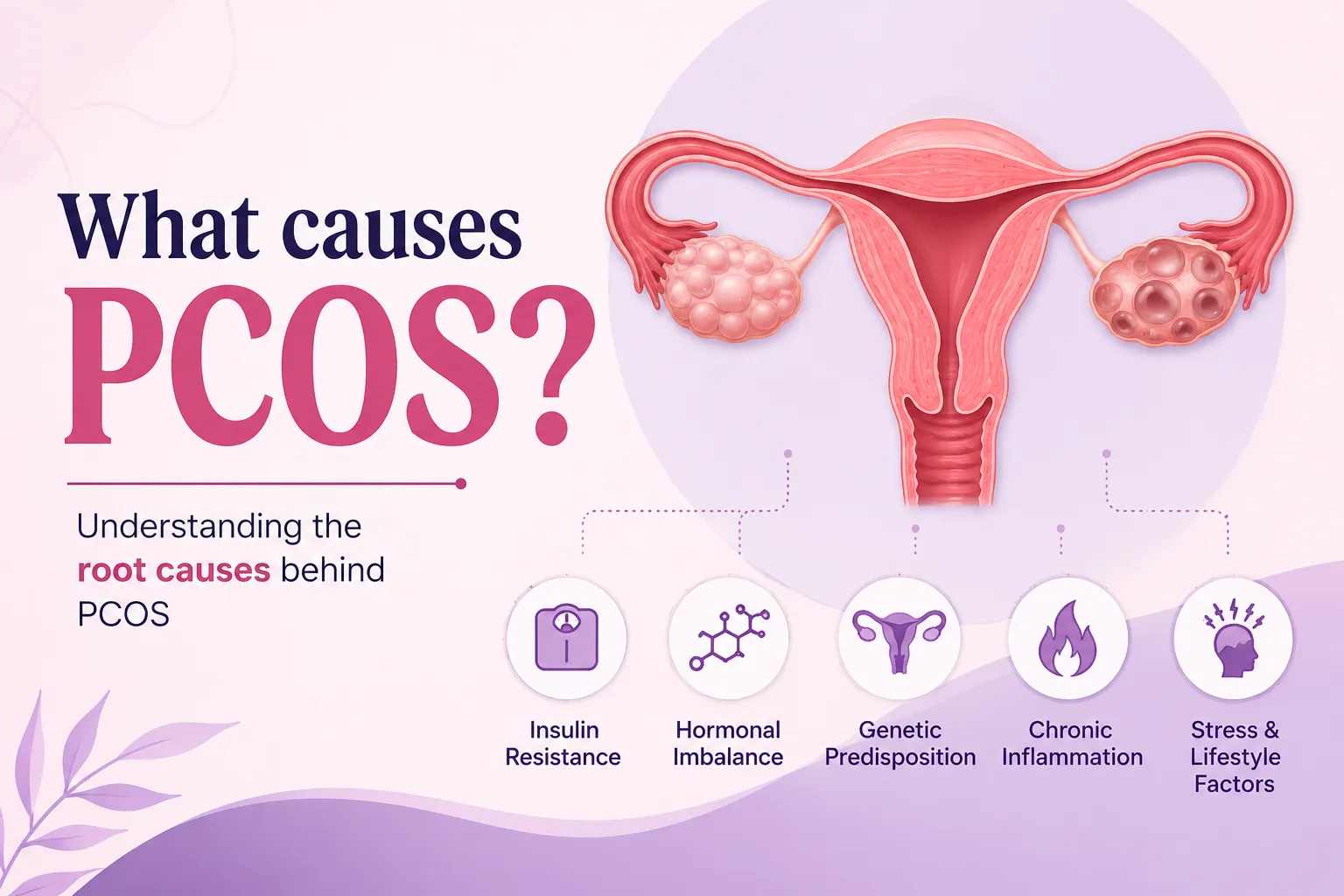
PCOS is one of the most common hormonal conditions in women, yet it is also one of the most misunderstood. Women often hear the diagnosis and immediately ask: why did this happen to me? Did I do something wrong? Is it my diet, my stress, my weight?
The honest answer is: PCOS does not have one single cause. It comes from several factors working together, and the combination looks different from one woman to the next. That is exactly why two women with PCOS can have completely different symptoms and respond differently to the same treatment.
If you are based in Islamabad or anywhere in Pakistan and you want real, clear answers about PCOS rather than vague reassurances, the best gynecologist in Islamabad for PCOS management will always start by mapping out your specific pattern of symptoms before recommending anything.
This blog breaks down each known cause of PCOS, what it means for your body, and why it matters for how PCOS is treated.
What Is PCOS, Briefly?
Polycystic ovary syndrome is a condition where the ovaries do not ovulate regularly. This leads to a build-up of small, fluid-filled follicles on the ovaries. The hormonal environment becomes disrupted: androgen levels (male hormones like testosterone) rise, progesterone drops, and the menstrual cycle becomes irregular or stops altogether.
The name can be a little misleading. Not every woman with PCOS has visible cysts on an ultrasound. The condition is diagnosed based on a combination of symptoms, blood tests, and imaging, not on the presence of cysts alone.
The Main Causes of PCOS
1. Hormonal Imbalance: Too Much Androgen
The most consistent finding in PCOS is elevated androgens. Every woman naturally produces small amounts of androgens like testosterone and DHEA-S, but in PCOS, the ovaries produce too much of them.
This excess androgen is responsible for many of the most visible symptoms: acne, excess facial or body hair (hirsutism), and scalp hair thinning. It also interferes with ovulation. When androgen levels are high, follicles in the ovaries develop but do not mature fully, so eggs are not released.
Why does this happen? In most cases, it comes down to a combination of insulin resistance and disrupted signaling between the pituitary gland and the ovaries. The pituitary gland releases LH (luteinizing hormone) and FSH (follicle-stimulating hormone) to coordinate ovulation. In PCOS, LH levels tend to be disproportionately high, which drives the ovaries to produce more androgens instead of maturing eggs normally.
2. Insulin Resistance: A Core Driver in Most PCOS Cases
Insulin resistance is present in roughly 70 to 80 percent of women with PCOS, and it is one of the most important factors to understand because it affects so much else.
When cells become resistant to insulin, the pancreas compensates by producing more of it. High insulin levels in the blood then act on the ovaries and trigger them to produce more androgens. This creates a loop: more insulin, more androgens, more disrupted ovulation.
Insulin resistance in PCOS is not always linked to body weight. Lean women can have significant insulin resistance too. This surprises many patients, but it explains why thin women with PCOS still struggle with irregular periods and elevated testosterone.
The practical implication is that managing insulin levels, whether through diet, exercise, or medication like metformin, can directly improve hormonal balance and menstrual regularity in many PCOS cases. Women looking for PCOS treatment in Islamabad often find that addressing insulin resistance is one of the first steps their doctor takes.
3. Genetic Factors: It Often Runs in Families
PCOS has a strong hereditary component. If your mother, sister, or maternal aunt has PCOS, your risk of developing it is significantly higher. Studies suggest that first-degree relatives of women with PCOS are two to three times more likely to have the condition themselves.
No single gene has been identified as "the PCOS gene." Instead, multiple genes appear to be involved, each contributing a small amount to the overall risk. These genes affect how the ovaries respond to hormonal signals, how the body processes insulin, and how androgens are metabolized.
The genetic piece also explains why PCOS can look different across families. One woman might have the insulin-resistant type, another might have predominantly hormonal symptoms, and a third might only discover she has PCOS when investigating fertility concerns.
4. Low-Grade Chronic Inflammation
Research over the past decade has shown that many women with PCOS have markers of low-grade chronic inflammation. This is not the kind of inflammation you feel after an injury. It is a persistent, low-level immune activation that affects how the ovaries function.
Inflammation appears to stimulate ovarian androgen production directly and may also worsen insulin resistance. Diet plays a role here: high intake of refined carbohydrates, sugar, and processed foods can increase inflammatory markers, which may worsen PCOS symptoms.
This is one reason why dietary changes can have a noticeable effect on PCOS, even without significant weight loss. Reducing the inflammatory load on the body eases some of the pressure on the hormonal system.
5. Disrupted Signals Between the Brain and Ovaries
The hypothalamus and pituitary gland in the brain work as the control center for the reproductive system. They send out timed hormonal signals that tell the ovaries when to develop a follicle, when to ovulate, and when to release progesterone after ovulation.
In PCOS, this timing is off. The hypothalamus releases GnRH (gonadotropin-releasing hormone) at a faster pulse rate than normal, which causes the pituitary to produce excess LH relative to FSH. This imbalanced ratio is what drives the ovaries toward androgen production rather than ovulation.
What disrupts the hypothalamic signal in the first place? This is still being studied, but insulin, androgens, and stress hormones all appear to interfere with it. It is circular: the hormonal imbalance of PCOS can worsen the very signaling disruption that caused it.
6. Weight and Adipose Tissue
Body fat, particularly fat stored around the abdomen, is metabolically active. Adipose tissue produces estrogens and pro-inflammatory molecules. In women with PCOS who are overweight, excess fat tissue worsens insulin resistance and adds to the inflammatory burden.
However, as mentioned above, weight is not a prerequisite for PCOS. Around 20 to 30 percent of women with PCOS have a normal BMI. In these women, other factors, such as genetic predisposition or the degree of insulin resistance at a cellular level, are more dominant.
Weight management is important for PCOS when it is a contributing factor, but it should not be treated as the only solution, and women with PCOS should not be told that the condition is simply a consequence of their weight.
7. Early Life and Fetal Environment Factors
Some research suggests that hormonal exposure in the womb may influence the risk of PCOS later in life. Girls born to mothers with elevated androgens during pregnancy may have a higher risk of developing PCOS. Early life nutrition and exposure to endocrine-disrupting chemicals (found in some plastics and pesticides) are also being studied as potential contributing factors.
This is an evolving area of research, but it adds another layer to why PCOS is a condition with multiple roots rather than a single, clear cause.
Does Stress Cause PCOS?
Stress alone does not cause PCOS, but it does not help. Chronic stress raises cortisol, which can worsen insulin resistance and directly suppress the hypothalamic-pituitary-ovarian axis. This can make cycles more irregular in women who already have PCOS.
Stress is more accurately described as a trigger or aggravating factor rather than a root cause. Women with PCOS often notice their symptoms worsen during high-stress periods. This is a real observation, not imagination.
Does Diet Cause PCOS?
Diet does not cause PCOS, but it influences how severe symptoms become. A diet high in refined carbohydrates, sugar, and trans fats worsens insulin resistance and inflammation. A diet built around whole foods, fiber, and lean proteins can measurably improve hormonal markers in women with PCOS.
This is worth understanding clearly. Many women feel guilty after a PCOS diagnosis, as though their eating habits caused the condition. That is not accurate. PCOS has a genetic foundation that cannot be reversed by diet. But what you eat does affect how the condition behaves day to day.
Why Understanding the Cause Matters for Treatment
PCOS is not treated the same way in every woman because it does not have the same cause in every woman. The right approach depends on which factors are most prominent in your case.
For women where insulin resistance is the main driver, metformin and dietary changes are often the priority. For women where androgen excess is causing acne and hair growth, anti-androgen medications or combined oral contraceptives may be used. For women trying to conceive, ovulation induction with medications like letrozole is the focus.
If you have been dealing with irregular periods, unexplained weight changes, acne, or fertility concerns, it is worth understanding what is actually driving your symptoms rather than receiving a generic diagnosis with no plan behind it.
Reading about the common symptoms, diagnosis, and treatment options for PCOS can help you go into your appointment with better questions and a clearer sense of what to expect.
How PCOS Is Diagnosed in Practice
Diagnosis typically follows the Rotterdam criteria, which requires at least two of the following three findings:
- Irregular or absent ovulation: Cycles that are consistently shorter than 21 days, longer than 35 days, or absent.
- Clinical or biochemical signs of excess androgen: Acne that does not respond to topical treatment, excess facial or body hair, scalp hair thinning, or elevated testosterone on a blood test.
- Polycystic ovarian morphology on ultrasound: The presence of 12 or more follicles in either ovary, or increased ovarian volume.
Other conditions, such as thyroid disorders, congenital adrenal hyperplasia, and hyperprolactinemia, need to be ruled out before a PCOS diagnosis is confirmed. This is why blood tests are a standard part of the workup.
PCOS and Fertility: What the Causes Mean for Getting Pregnant
The disrupted ovulation in PCOS is the main reason why PCOS is one of the leading causes of female infertility. If eggs are not being released regularly, conception is difficult.
But PCOS does not mean infertility. Many women with PCOS conceive naturally or with minimal intervention. Ovulation induction, lifestyle modifications, and where needed, IUI or IVF, are all options. The success of treatment depends partly on how well the underlying causes, particularly insulin resistance, are managed before conception is attempted.
Dr. Farwa Hameed has a full video explaining PCOS causes, symptoms, and treatment options in plain language: watch PCOS explained: causes, symptoms, and treatment to understand what the condition actually involves before your next appointment.
When Should You See a Doctor About PCOS?
If your periods are consistently irregular, if you are struggling with acne or unexplained hair growth, or if you have been trying to conceive for more than six months without success, a proper evaluation is worth having. A gynecologist can run the right blood tests and ultrasound to confirm whether PCOS is involved and, if so, which factors are driving it in your specific case.
Waiting to see if things improve on their own is reasonable for mild symptoms, but it is not a substitute for diagnosis, particularly when fertility is a concern or when symptoms are significantly affecting your quality of life.
Medical disclaimer: This article is for patient education only and does not replace professional medical advice. Please consult a qualified doctor for personal medical guidance.